Techinno Health Branded Ingredient — Urolithin A
Patents · Regulatory Considerations · Mechanisms of Action · Formulation Combinations · Human Data
Why Urolithin A
Urolithin A has been one of the anti-aging ingredients attracting the most scientific and investment interest over the past decade. It is also among the anti-aging ingredients with the most extensive human clinical research, and is regarded as a representative molecule in the emerging field of “cellular nutrition.”
The Swiss company Amazentis, which developed it into a branded ingredient under Timeline, has helped establish a global category: Nestlé Health Science acquired a stake in 2019 and secured worldwide rights to use it in dietary supplements, food and beverages, and medical nutrition; L’Oréal’s BOLD venture fund led its CHF 56 million Series D round, supporting its move into anti-aging skin care. Two major companies investing in the same ingredient in succession is itself a sign of the category’s maturity. In supplements, the category has reached the hundreds-of-millions-of-US-dollars scale and is expanding at a projected compound annual growth rate of approximately 15–20% (industry forecast).
There is, however, a barrier to entry: core patents in this category are firmly held by the original developer, and enforcement is a reality.
After more than two years of work, Techinno Health has developed its own research direction: promoting ribosome biogenesis and nascent protein synthesis, and has filed a PCT international patent application (application number PCT/CN2026/135162).
At Techinno Health, our mission is to make life ten years younger. Supporting that vision is our end-to-end capability, from ingredients and mechanisms of action to formulations and finished products. Connecting the full development process is what makes it possible to study Urolithin A in depth and turn application concepts into practical products.
When brands ask about Urolithin A, the question is never simply, “Is it good?”
They ask: Is the ingredient reliable? Are there patent risks? Is there evidence for its effects? How should it be formulated? Are human data available?
For Techinno Health’s Urolithin A program, one principle applies: every claim is supported by evidence.
First, the Molecule
Urolithin A is not present in any food.
Pomegranates, berries, and walnuts contain only its precursors, ellagitannins. Producing Urolithin A requires two stages of metabolism by the gut microbiota.
Whether a person can produce it, and how much, depends on their microbiota:
- During childhood, approximately 80% of people can produce it themselves.
- Above age 40, that proportion falls to approximately 55%.
- Approximately 10% of people do not produce it at all.
Those who most need supplementation are precisely those whose own production is declining.
Evidence A Spanish cohort of 839 people aged 5–90; Cortés-Martín et al., Food Funct 2018
I. Patents
A new pathway developed in-house, with a PCT international patent application accepted.
- Application number: PCT/CN2026/135162
- Acceptance date: October 21, 2026 (receiving office: China National Intellectual Property Administration)
- Applicant: Ningbo Tech-Inno Health Industry Co., Ltd.
- Invention title: Urolithin A Compositions and Methods for Enhancing Ribosome Biogenesis and Tissue Protein Synthesis
The technical content will not be publicly disclosed before international publication. Partner customers may review it after signing a confidentiality agreement.
TI-3N® three-ingredient composition: published in China and internationally under the PCT.
Urolithin A + fisetin + ergothioneine.
- Chinese invention patent application: CN120078657A (filed February 28, 2025; published June 3, 2025); applicant: Guangdong Qingyunshan Traditional Chinese Medicine Innovation Research and Development Co., Ltd. (广东青云山中药创新研究开发有限公司)
- PCT international application: PCT/CN2026/080403
- International publication number: WO 2026/179956 A1 (published September 3, 2026)
- U.S. national phase entry is in progress.
UA Patent Fortnightly Brief.
Every two weeks, our scientific department works with a U.S. law firm to review the latest patent developments in Urolithin A. The brief is issued following review by the legal team. Partner customers can subscribe free of charge.
II. Regulatory Considerations: FTO and Filing
Patent analysis of the current manufacturing process: limited to the literal scope of independent process claims.
- August 2026: completed an FTO search report on the current manufacturing process.
- October 2026: received a written non-infringement opinion from a U.S. patent attorney.
The opinion covers 14 U.S. patent records—9 granted patents and 5 published applications—and concludes that the current manufacturing process does not fall within the literal scope of the independent process claims in those records. A technical comparison was also completed against 15 Chinese patent records.
Partner customers may review the full opinion under a confidentiality agreement.
Why this matters.
Patents covering Urolithin A’s core effects, compositions, and dosage forms have been filed in major markets, and enforcement by the original developer has taken place:
- October 2025: the original developer sued 30 online sellers in U.S. federal court.
- July 2026: a judgment permanently enjoined 19 sellers and awarded more than US$5.3 million in total damages.
- October 2026: a temporary restraining order was obtained against 35 counterfeit domains.
This analysis covers only the manufacturing process and the literal scope of independent process claims in the listed records. It does not replace patent assessments for ingredients, compositions, uses, or target markets, and is not a comprehensive freedom-to-operate guarantee.
Cosmetic-grade filing and safety.
- China’s new cosmetic ingredient filing for Urolithin A: 国妆原备字20250106 (INCI: Urolithin A), with skin protectant as its filed function category; filing entity: Guangdong Qingyunshan Traditional Chinese Medicine Innovation Research and Development Co., Ltd. (广东青云山中药创新研究开发有限公司).
- An ingredient safety assessment report is available.
- Human patch test of the 98% ingredient: 30 participants, 0 adverse reactions.
III. Mechanisms of Action
Techinno Health’s own research: a new pathway involving ribosomes and protein synthesis.
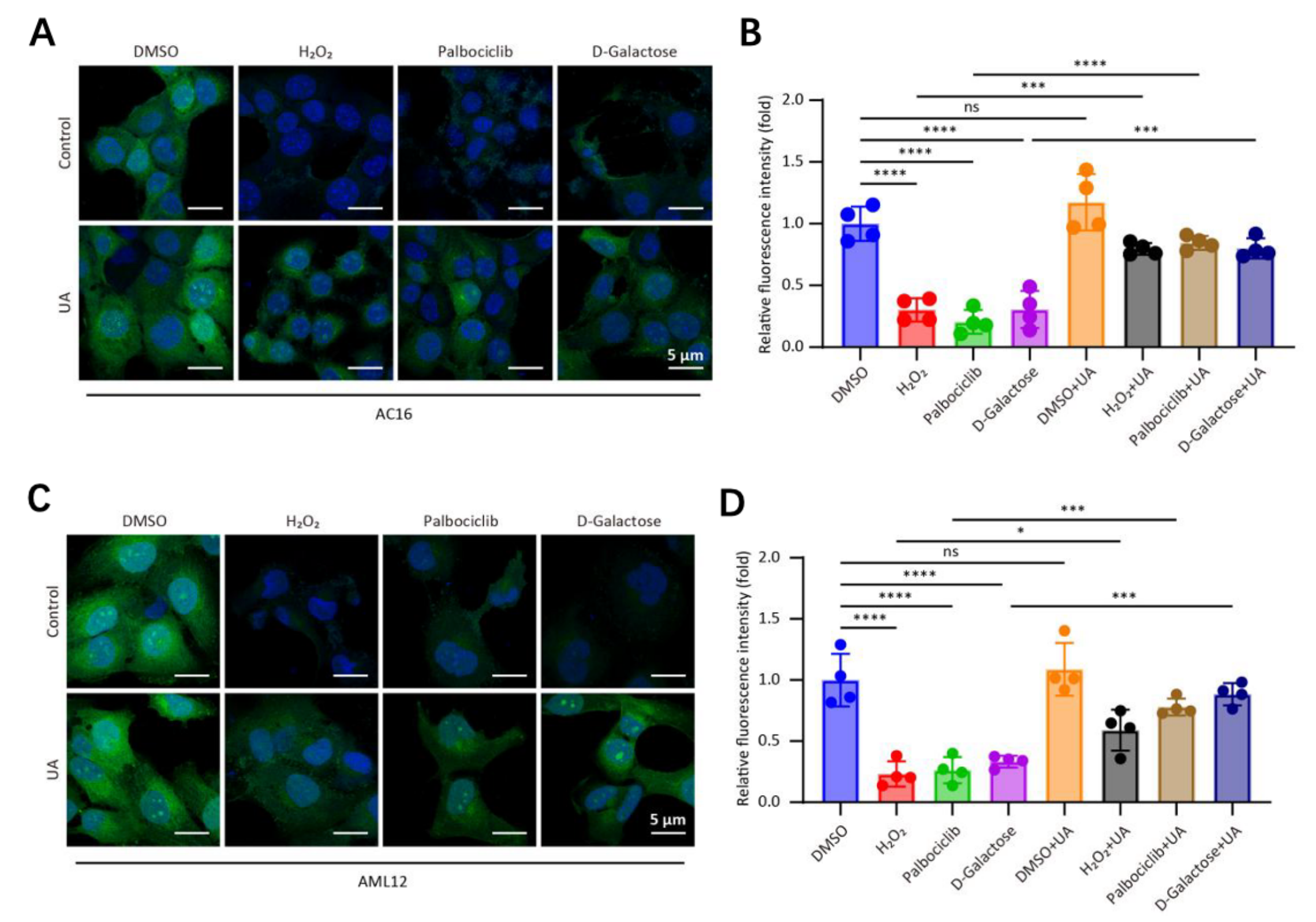
We measured nascent protein synthesis using HPG labeling, establishing three injury models in each cell type:
- Cells (including): cardiac AC16 · liver AML12
- Injuries: oxidative stress (H₂O₂) · cell-cycle arrest (palbociclib) · glycation-related senescence (D-galactose)
Results:
- All three injuries reduced nascent protein synthesis to approximately 20–35% of the control level.
- Following the addition of 5 µM MitoIgnite®, synthesis increased 2–3-fold.
- Most groups showed p<0.001 or p<0.0001 (n=4).
- Basal synthesis levels in uninjured cells were unaffected.
Research source Techinno Health’s internal cell studies. The mechanism was introduced in a NutraIngredients promotional feature on October 26, 2026; this is not a peer-reviewed paper or independent research validation. PCT/CN2026/135162 was filed around this research direction.
IV. Formulation Combinations
TI-3N®: synergy seen only when all three are combined.
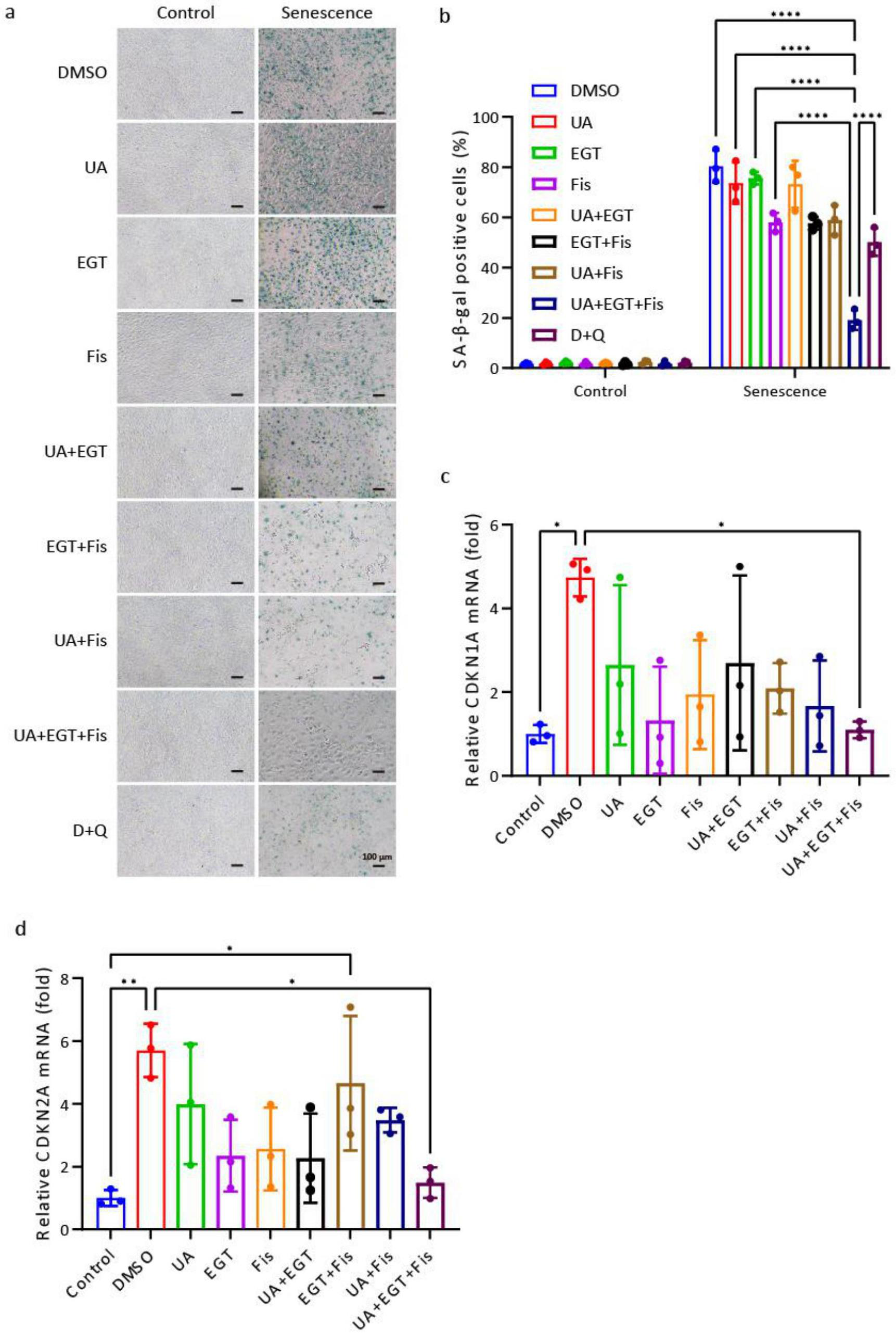
Model: UVB-induced senescence in human skin fibroblasts (BJ cells).
- Proportion of senescence-positive cells (SA-β-gal): approximately 80%.
- Urolithin A, fisetin, or ergothioneine used individually: no significant reduction.
- Any two-ingredient combination: reduced the proportion only to approximately 60%.
- All three combined: reduced the proportion to approximately 20% (p<0.0001), outperforming the dasatinib + quercetin control in the same experiment (approximately 50%).
Other measures with the three-ingredient combination:
- Senescence-associated genes p21 and p16, which increased approximately 5–6-fold after UVB exposure, returned to near-normal levels.
- IL-6, IL-8, and IL-11, which increased 6–12-fold, returned to approximately 1-fold.
- Intracellular ROS returned to the level observed without irradiation.
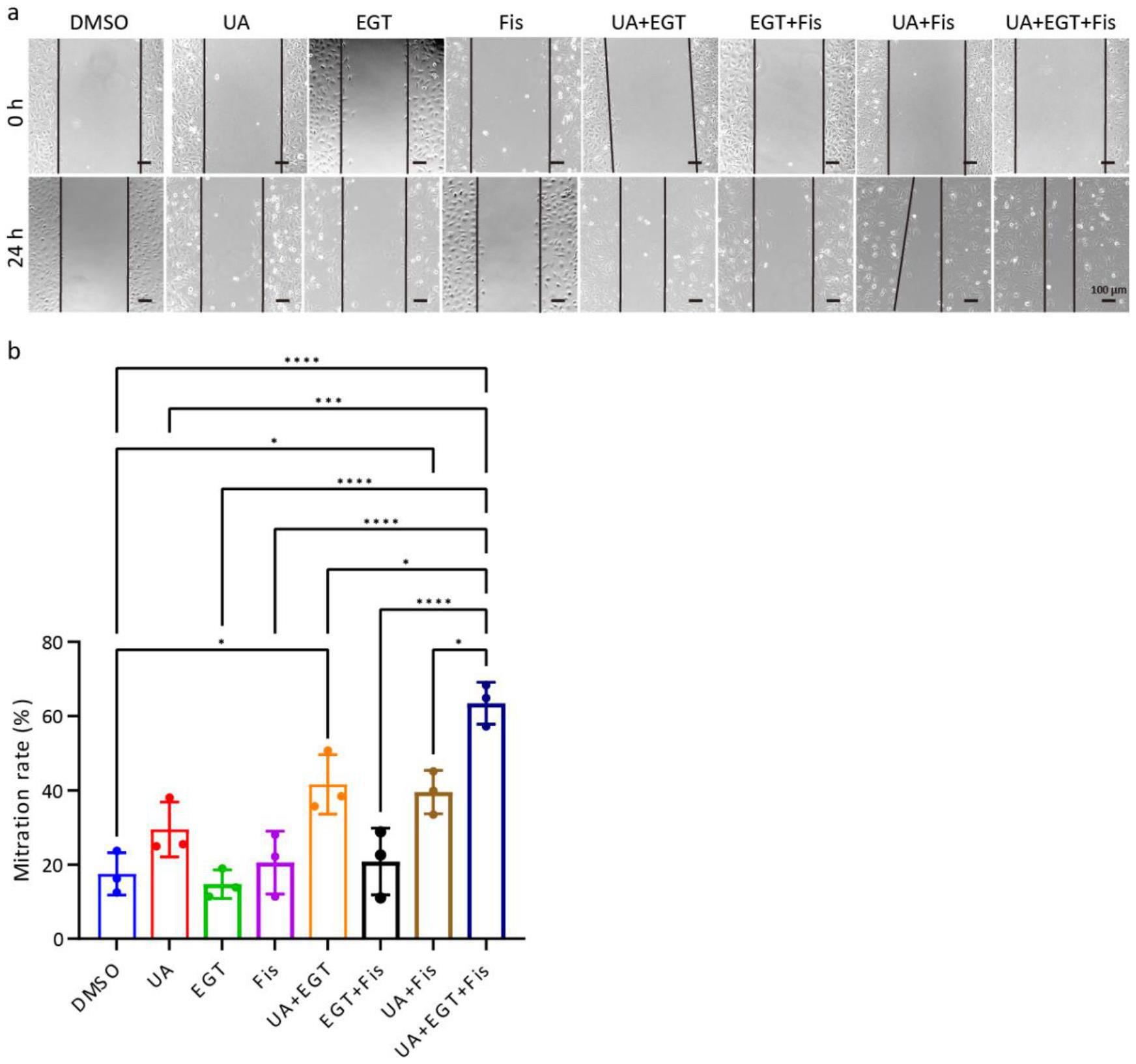
- Scratch-assay migration was 63%, compared with 17% in the control (p<0.0001).
Evidence Data from published patent application CN120078657A; the original figures are shown below.
A cellular homeostasis approach for stressed skin.
At this year’s PCHi Leadership Summit, Scientific Director Kelly Yang presented the combined use of Urolithin A and fisetin in skin-repair applications.
Solving incorporation challenges.
Urolithin A has low water solubility. Poor dispersion and formulation instability are often the first challenges formulators encounter.
- MitoYouth® WS water-dispersible grade ≥10%: starch-based carrier, physical blending only, preservative-free; can be added directly to the aqueous phase. Recommended use level: 1–5%. Commercial production is underway.
- 80% powder: recommended use level of 0.1–1%, for oil-phase and solid formulations.
- MitoIgnite® 99% oral grade: capsules, tablets, powders, and beverages.
From ingredient to finished product.
Ingredient → efficacy-oriented formulation proposal → finished-product sampling → efficacy verification → finished-product solution. Customers can enter at any stage, supported by Techinno Health’s ODM capabilities.
V. Human Data
Techinno Health’s own human efficacy evaluations (using Techinno Health products).
- TI-3N® oral combination | 20 women aged 36–60; 56 days; within-participant before-and-after comparison | Skin elasticity R2 +9.61%, under-eye wrinkle area −11.28%, TEWL −17.18%
These evaluations were conducted by Techinno Health’s scientific laboratory and efficacy evaluation platform, using the framework for cosmetic efficacy evaluation.
Two Ingredient Grades, One Supplier
- MitoIgnite® oral grade: purity ≥99% (HPLC testing of every batch), with specifications, COA, and MSDS available.
- MitoYouth® cosmetic grade: filing number 国妆原备字20250106; 80% powder / WS water-dispersible grade ≥10%; documentation for nine safety assessments.
Specifications, COAs, samples, and the UA Patent Fortnightly Brief are available upon application after verification that the applicant is a brand or manufacturer.
Contact: ty-sales@taiyi-nb.com Website: techinnohealth.com
This article shares ingredient information for business customers. It does not constitute a promise of efficacy, medical advice, or a legal opinion. All third-party human studies are published literature using third-party formulations. Our own cell studies are early findings and do not establish effects in humans. Human cosmetic efficacy evaluations follow the framework for cosmetic efficacy evaluation. Content in pending patent applications does not mean that any claims have been granted. MitoIgnite®, MitoYouth®, and LicorPure® are the respective registered trademarks.
All news